
Honey is what we think of first when we think of bees.
In the UK Honey Regulations define honey as :
- natural sweet substance produced by Apis melifera
- made exclusively from one or more of:
- nectar of plants
- secretions of living plants
- excretions of plant-sucking insects
- collected by the bees
- combine with specific substances of their own
- dehydrated by the bees
- stored and left in honeycombs to mature
Further definitions from the Honey Regulations
- Baker's honey:
honey for industrial use or as an ingredient in another foodstuff which is then processed - Blossom honey and nectar honey:
obtained from the nectar of plants - Chunk honey and Cut Comb in honey:
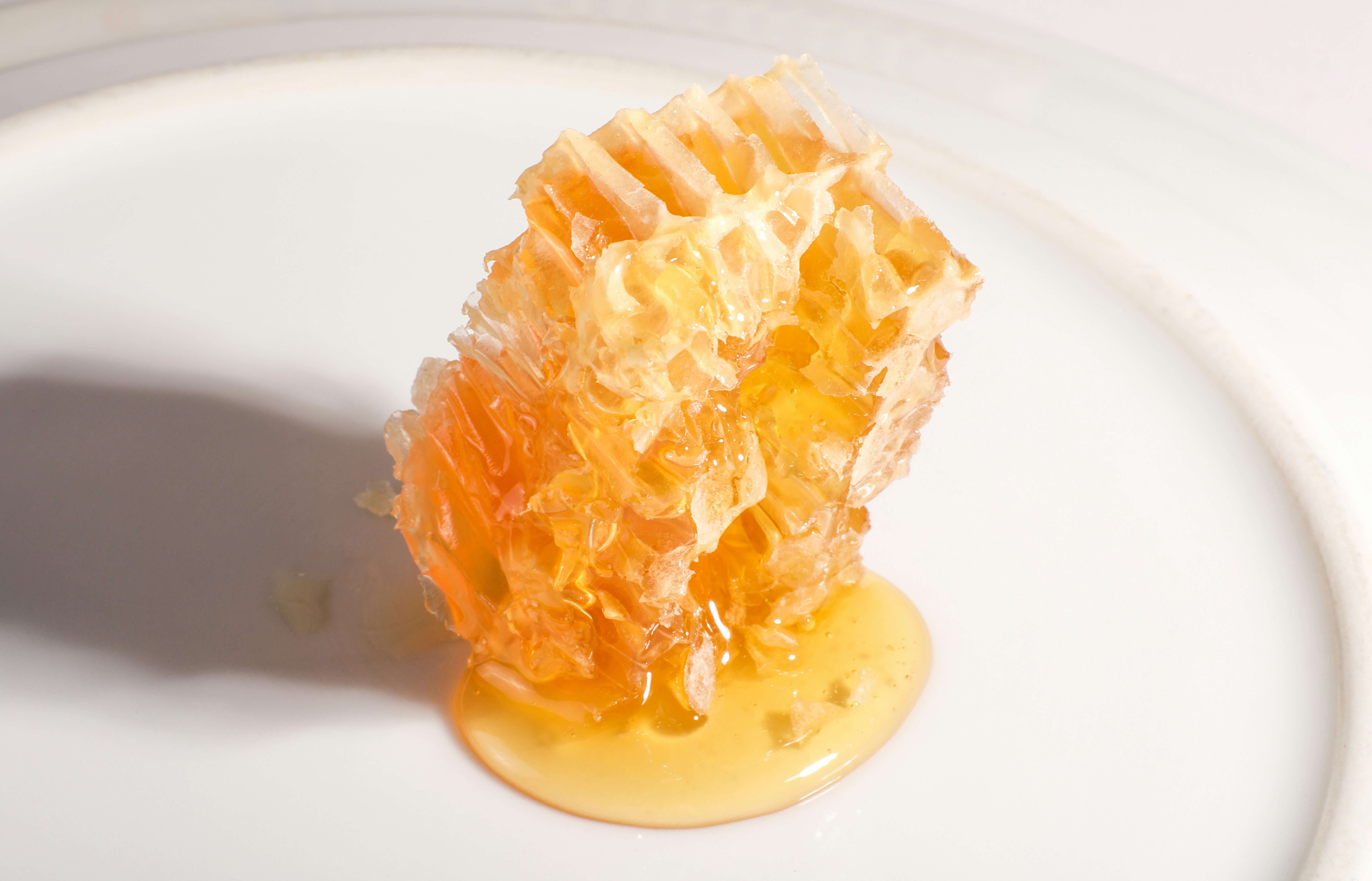
contain one or more pieces of comb honey; - Comb honey:
stored by bees in cells of honey comb they made and sold in the whole comb or part of it; - Drained honey:
obtained by draining de-capped broodless combs - Extracted honey:
honey obtained by centrifuging de-capped broodless combs; - Filtered honey:
highly filtered in a way that removes a significant amount of pollen - Honeydew honey:
mainly made from excretions of plant sucking insects and/or the secretions of plants; - Pressed honey:
made by pressing combs with or without heat of up to 45° C. Raw Honey
There is no legal definition of raw honey.
Honey comes in several forms:
- Runny honey This drips off the spoon
- Soft set honey This can be easily spread
- Set honey This is difficult to spread
- It can be made spreadable.
- Place it in water kept at no more than 40C
- Stir it every so often
- Once clear it will remain like that for some time
- Creamed honey This has the consistency of peanut butter.
- Made by adding a small amount of crystalised honey
- Then stirred as it crystalises
- Stirring prevents crystals growing larger
- Much like the stirring in an ice cream maker
- It is not whipped but stirred
- Whipping would add air. We don't want honey foam!
- Cut Comb honey This is as described above.
- Heather honey From bees foraging on Ling or Common Heather
- It is often dark amber colour
- It is set like jelly till stirred - thixotropic
- It has a robust strong flavour
- More expensive due to demand greater than supply
- This is due to a short flowering season for the heather.
- Manuka honey From bees foraging on the Manuka plant.
- Manuka Leptospermum scoparium found in New Zealand and parts of Australia
- Contains Methylglyoxal (MGO) with antibacterial properties.
- Genuine Manuka honey has a UMF™ (Unique Manuka Factor) rating of 10+ or higher
- The UMF measure the amount of methylglyoxal and leptosperin
- It is suggested there is more "Manuka Honey" sold than is made!
- There is some evidence that it aids healing of burns and other wounds
- Further reading
- So what is honey?
- Why do bees make honey?
- How do we get honey from the hive?
- What are the labelling rules for honey?
- Mead - I will drink to that.
- The dark side of honey - adulteration