
Routine Hive Inspection
Planing ahead- Only inspect when you have a reason
- Not for idle curiosity
- Plan ahead
- Have a definite aim in mind.
- Make a list of the tools you will need
- Make a list of hive parts you need
- Make a list of anything else you need
- Collect together all you need:
- Anything extra from the list above
- Bee suit, hat and sweat band
- Boots, gloves and disposable gloves
- Smoker and fuel and lighter
- Hive tool
- Waste tub
- Tub of washing soda solution
- Note book and ball point/pencil
- Mobile phone
- First aid kit with anti-histamine tablets
- Water - to swallow tablet?
- Light the smoker
- Put on your beesuit etc.
- Put phone in your bee suit pocket
- Approach from behind or the side
- That way the guard bees don't see you.
- Are the bees active?
- Are they bringing back pollen?
- Pollen is a sign they need protein for the brood.
- Is their Asian Hornet hawking?
- Are there many dead or dying bees outside the hive?
- Suspect insecticides.
- Are their new stains on the front of the hive?
- This is a sign of possible Nosema
- Is there fighting on the landing board?
- Could be a sign of robbing.
- Restrict hive entrance.
- Ask yourself why there is robbing.
- Have you recently fed them at the wrong time of day?
- Is the colony weak? Why?
- Puff smoke a couple of times into hive entrance.
- Stand behind or to one side of the hive.
- If frames are warm way stand behind the hive
- If frames are cold way stand to side of hive
- In warm way frames parallel with entrance.
- It is said to make the hive warmer.
- In cold way frames run front to back.
- Said to make hive colder as wind whistles through.
- Lift of the lid, invert and put on ground.
- Sniff in the hive - smell good?
- Listen are they active or angry?
- If sound level rises they are angry.
- Best to withdraw and come back later.
- Lift up crown board
- Shake any bees into the hive.
- Invert crown board and put on roof on ground.
- Best to put crown board at angle so it is on the roof not in it.
- Remove spacer board from end of super
- Place this on the roof you removed.
- Ease the first frame away from the other frames.
- Lift it out and look at the bees.
- Looking for Deformed Wing Virus
- Appears as shrivelled wings.
- Looking for Chronic Bee Paralysis
- Appears as black hairless bees.
- Shake off the bees
- Short, sharp shake over the hive.
- Is there any brood present?
- If there is the queen is in the super!
- Are there food stores?
- Is there room for more stores?
- If not then add a super.
- Repeat this for several of the frames.
- There is no need to check all frames
- Remove the super and place on the crown board you previously removed.
-
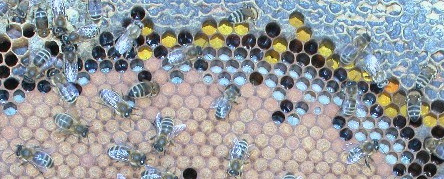
Healthy Brood
-
- Lift of the Queen excluder.
- Shake the bees onto the top of the frames
- Remove the first frame
- Check the bees as above.
- Inspect the brood.
- Are their eggs in any cells?
- If there are eggs then there is probably a laying queen
- Are there more than one in any cells?
- Many eggs near top of cell suggests laying workers.
- Two or three eggs at base of cell suggests a new queen.
- Are there brood cells with sunken, greasy cappings?
- Suspect American Foul Brood
- You must contact your bee inspector.
- Are there uncapped larvae with no segmentation?
- Suspect European Foul Brood
- You must contact your bee inspector.
- Are there larvae which are hard chalky pellets?
- Suspect Chalkbrood
- Are there larval remains which are yellow to dark brown?
- Suspect Sacbrood
- Look for the queen
- If she is not marked then mark her.
- Are there any queen cells present?
- If they are in the centre of a frame suspect "supersedure".
- If they are at the edge of a frame suspect swarm preparation.
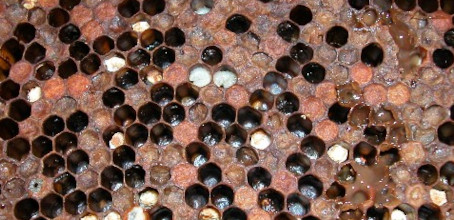
Courtesy The Animal and Plant Health Agency (APHA), Crown Copyright
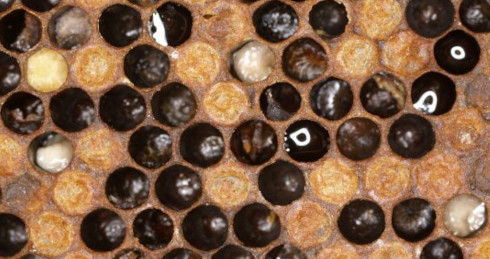
Courtesy The Animal and Plant Health Agency (APHA), Crown Copyright
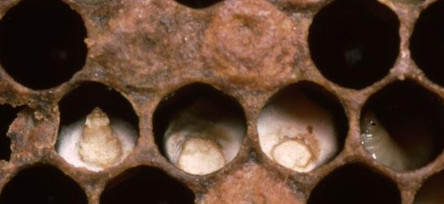
Courtesy The Animal and Plant Health Agency (APHA), Crown Copyright
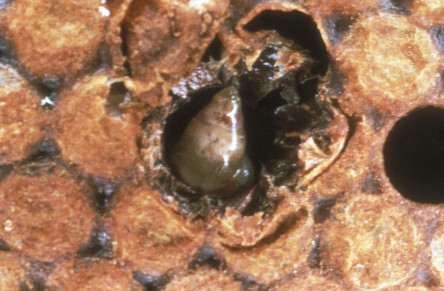
Courtesy The Animal and Plant Health Agency (APHA), Crown Copyright